
CABM highlights women making history

For this year's Women's History Month in March, CABM highlighted outstanding female scientists who have a close connection to either Rutgers University or New Jersey.
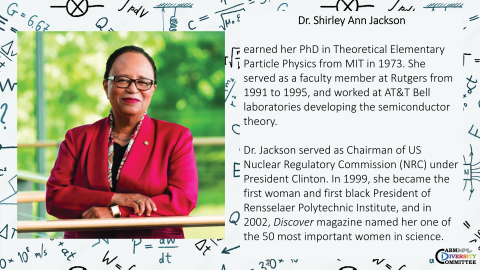
Dr. Shirley Ann Jackson earned her PhD in Theoretical Elementary Particle Physics from MIT in 1973. She served as a faculty member at Rutgers from 1991 to 1995 and worked at AT&T Bell laboratories developing the semiconductor theory. She served as Chairman of US Nuclear Regulatory Commission (NRC) under President Clinton. In 1999, she became the first woman and first black President of Rensselaer Polytechnic Institute and in 2002, Discover magazine named her one of the 50 most important women in science.

Dr. Lynn Margulis was an evolutionary biologist who pioneered the "Endosymbiosis Theory." In 1966, she hypothesized that the mitochondria developed from a bacterium that lived inside a eukaryote. Nearly fifteen journals rejected her initial paper entitled, "On the Origin of Mitosing Cells," but Margulis persisted. In 1978, experimental evidence supported her theory. Fifteen universities awarded her honorary doctorates for her contribution to science and in 1999, President Clinton gave her the National Medal of Science. In 2002, Discover named her one of the 50 most important women in science.
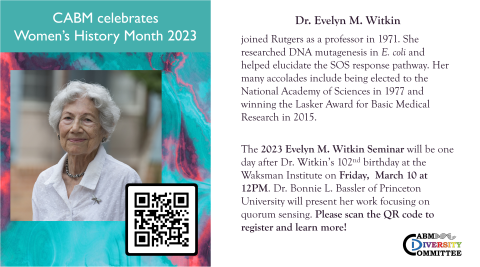
Dr. Evelyn M Witkin joined Rutgers as a professor in 1971. She researched DNA mutagenesis in E. coli and helped elucidate the SOS response pathway. Her many accolades include being elected to the National Academy of Sciences in 1977 and winning the Lasker Award for Basic Medical Research in 2015. The 2023 Evelyn M. Witkin Seminar will be one day after Dr. Witkin's 102nd birthday at Waksman Institute on Friday, March 10 at 12pm.
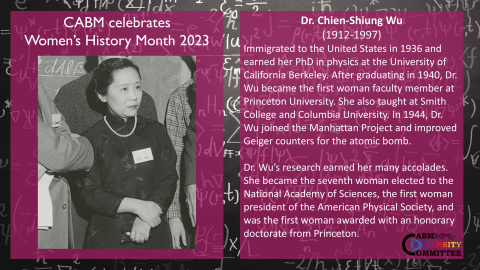
Dr. Chien-Shiung Wu immigrated to the United States in 1936 and earned her PhD in physics at the University of California Berkeley. After graduating in 1940, Dr. Wu became the first woman faculty member at Princeton University. She also taught at Smith College and Columbia University. In 1944, Dr. Wu joined the Manhattan Project and improved Geiger counters for the atomic bomb. Her research earned her many accolades. She became the seventh woman elected to the National Academy of Sciences, the first woman president of the America Physical Society and was the first woman awarded with an honorary doctorate from Princeton.